


What is LoRaWAN?
LoRaWAN stands for “Long Range Wide Area Network” and refers to an energy-efficient network protocol with a very long range that was specially developed for the Internet of Things (IoT) and is based on LoRa radio technology. LoRaWAN therefore offers the possibility of transmitting data over long distances in an energy-saving manner.
It belongs to the so-called LPWAN technologies (Low Power Wide Area Networks, LoRaWAN Alliance) and impresses with a battery life of up to 10 years, depending on the sensor type and the frequency of data transmission.
Depending on the environment and external influences, LoRaWAN can bridge distances of up to 15 kilometers, which enables high network coverage. Another major advantage is the excellent building penetration. However, the combination of low power consumption and long range limits the maximum data rate to 50 kbit/s.
LoRaWAN is operated in the ISM band (frequency range from 867 to 869 MHz) and can be used nationwide in Germany without a license. Compared to other radio technologies such as mobile radio or WLAN, LoRaWAN is therefore particularly economical. These properties make LoRaWAN an ideal technology for the Internet of Things (IoT).
What is LPWAN?
Low Power Wide Area Networks (LPWANs) are often also referred to as Low Power Networks (LPNs) and are wireless networks that cover a large geographical area. They were specially developed for Internet of Things (IoT) applications, are used to transmit small IoT data packets and are characterized by low energy consumption.
Such wireless networks are very well suited to meeting the challenges of data transmission in a city, community or within a building. Sensors and actuators can send or receive IoT data, usually battery-powered, for several years. The best-known technologies include LoRaWAN, Sigfox, EnOcean and NB-IoT, all of which have very similar characteristics.
What is the difference between LoRa and LoRaWAN?
LoRaWAN describes the standard communication protocol and the system architecture for the entire network and enables standardized communication between the individual network participants. This means that LoRaWAN-capable products can be easily integrated into an existing LoRaWAN.
LoRa, on the other hand, refers to the physical radio technology developed by the Semtech Corporation that enables energy-efficient and long-range communication. LoRa is only used between the node (e.g. a sensor) and the gateway. The gateway, on the other hand, usually communicates with the network server via LTE/LAN and makes the data available to the Internet of Things.
The communication protocol and the system architecture have the greatest influence on the battery life of an end device (node), the network capacity, the security and the variety of applications served by the network.
How is LoRaWAN structured?
There are typically three components in a LoRa wide area network:
– LoRa Nodes,
– LoRa gateways and
– LoRa Server.
These are usually arranged in a star topology. Nodes are end devices such as sensors or actuators and transmit data packets to LoRa gateways, which in turn send the collected information to a LoRaWAN server. The data is encrypted by the end device and only decrypted on the server or in the application. Communication is usually bidirectional. The gateways, on the other hand, do not communicate via LoRa but are connected to the network server via a standard IP connection.
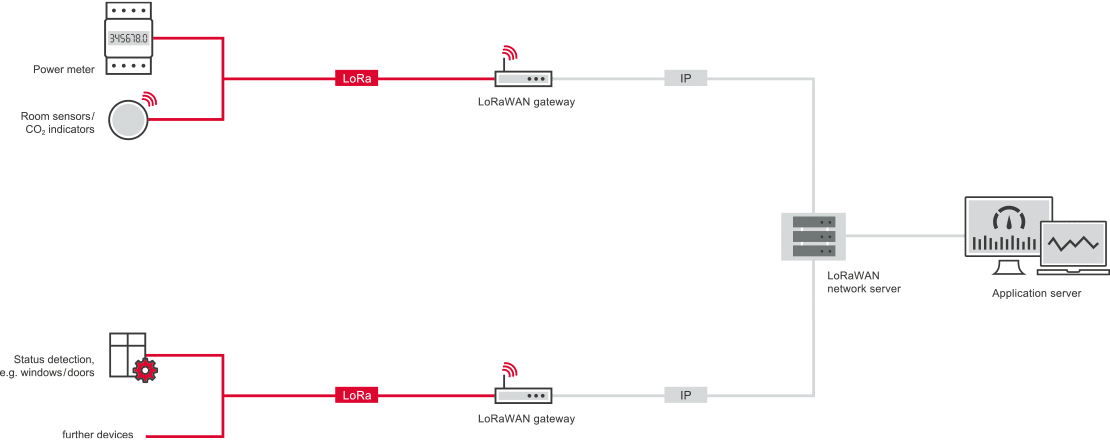
LoRa network server (LNS)
The LoRa network server performs a variety of tasks. For example, it manages the data rate used for each end device in the network individually using an adaptive data rate algorithm (ADR). The selection of the ideal data rate is a compromise between the duration of the message transmission and the reception range. The LoRaWAN data rates range from 0.3 kbit/s to 50 kbit/s. This maximizes the battery life of the end devices and thus enables energy-efficient operation. As the data packets sent by end devices are not necessarily only received by a gateway and forwarded to the server, the server must filter out the redundant data and delete superfluous data packets. This makes data transmission in a LoRaWAN very secure. The re-encryption of messages to end devices is also one of the tasks of the network server and ensures security.
LoRa end devices
Class A power amplifiers
Your Subtitle Goes Here
Communication with Class A end devices operates according to the ALOHA method. After each transmitted data packet (uplink) to the gateway, two reception windows (downlink) are available during which the end device is ready to receive data. This provides an opportunity to transfer information, such as device parameters, from the application to the end device. After communication, Class A end devices switch to power-saving mode and are not reactivated until the next uplink interval. This can result in changed values being written to the end device only after a considerable delay. On the other hand, this makes Class A end devices the most energy-efficient devices with very long battery life. Typical examples of Class A end devices include window contacts or level and leak sensors.
Class B power amplifiers
Your Subtitle Goes Here
Zusätzlich zu den Übertragungsfenstern von Klasse A Geräten, öffnen Endgeräte der Klasse B weitere Empfangsfenster (Downlinks) zu vordefinierten Zeiten. Aufgrund dieser vordefinierten Zeitfenster ist die maximale Latenz auf bis zu 128 Sekunden programmierbar. So wird sichergestellt, dass spätestens nach einer festgelegten Zeit ein Empfangsfenster geöffnet wird und Daten geschrieben werden können. Die höhere Empfangskapazität sorgt für zusätzlichen Energieverbrauch durch das Endgerät. Dennoch können batteriebetriebene Anwendungen problemlos mit Klasse B Geräten realisiert werden. Typische Beispiele für Endgeräte der Klasse B sind Temperatur- und Feuchtesensoren.
Class C power amplifiers
Your Subtitle Goes Here
Class C end devices have a permanently open receive window when they are not transmitting themselves, and thus exhibit the lowest latency among LoRa end devices. However, this in turn results in increased power consumption. Depending on the application and the end device, some Class C devices are also powered by an external power supply. A typical example of this is I/O modules.
How does LoraWAN work?
LoraWAN works with the LoRa technologyLoRa uses a special modulation modulation technique called Chirp Spread Spectrum (CSS)which enables high sensitivity and range. Depending on the environment and topography, the signals can cover distances of several kilometers.
CSS is a modulation technique in which the frequency of the signal varies continuously or “chirps”.
This technique has several advantages:
- Long rangeCSS enables the transmission of signals over long distances – often several kilometers – even in urban areas.
- Low energy consumptionThe modulation is very energy-efficient, which extends the battery life of the end devices.
LoRaWAN in building automation
In building automation and especially in smart buildings, the focus is on data transparency in order to operate buildings as energy-efficiently as possible. LoRaWAN was developed for the requirements of the Internet of Things (IoT) and impresses with high radio range and excellent building penetration. In this way, even entire company buildings with associated company grounds can be covered by just one gateway. Even the basement, which is often difficult to integrate into wireless networks, does not pose a problem for LoRa radio networks. Due to the small amount of data that IoT sensors and actuators consume, almost any number of sensors can communicate with the network server through a single gateway. This makes the integration of LoRa wireless sensors very favorable, since neither a large number of gateways nor repeaters are required.
In addition, low-power data transmission enables energy-efficient operation of LoRa sensors and LoRa actuators with batteries. At the same time, these can have a battery life of up to 15 years. This reduces the maintenance effort in facility management to a minimum and makes retrofitting in existing buildings child’s play, as no cables have to be subsequently pulled. For integration into an existing building automation system, some LoRa gateways already have standardized building automation interfaces such as Modbus. This means that collected data from LoRa end devices can easily flow back into the building automation system. This communication works bidirectionally and enables simple and cost-effective integration.
LoRaWAN application examples in buildings
LoRaWAN has clear advantages and is steadily growing in popularity and importance. But what exactly should LoRaWAN solutions be used for in the field of building automation? With application examples from the smart building sector, we present some of the most interesting use cases.
Advantages of LoRaWAN
LoRaWAN offers you numerous advantages. Discover them now.


LoRaWAN compared to other wireless technologies
LoRaWAN offers unique advantages compared to other wireless technologies such as Wi-Fi, Bluetooth and mobile networks, especially for applications in the Internet of Things (IoT). The biggest advantage of LoRaWAN is its range and energy efficiency. With a range of up to 15 kilometers in rural areas and extremely low energy requirements, it is ideal for IoT devices that need to operate independently over long periods of time.
In contrast, technologies such as Wi-Fi and Bluetooth have a much shorter range and higher energy consumption, making them less suitable for large-scale IoT networks. Although mobile technologies such as LTE or 5G offer higher bandwidth and speed, they consume significantly more energy and are often more expensive to implement. LoRaWAN scores particularly well in applications that require wide coverage and long battery life, such as smart cities or the monitoring of environmental parameters.
LoRa
Data throughput: Up to 50 kbit/s
Range: Rural up to 50 km &urban up to 5 km (values under optimal environmental conditions). As LoRaWAN was developed for long ranges & can penetrate several buildings, we are talking here about ranges in rural & urban areas.
Penetration: Very high penetrationin the building. In some cases, entire buildings can be covered with one gateway. Storeys and basements are no problem.
Energy requirement: Very low. Battery operation possible for several years.
Provisioning costs: Low
Integration of end devices: An almost infinite number of IoT devices can be connected to a LoRa gateway.
Scalability: New end devices can be added to the existing network “over the air” and log into it automatically (OTAA). New gateways may have to be used.
IoT suitability: Yes
WiFi
Data throughput:Up to 9600 Mbit/s (Wi-Fi 6)
Range: Outdoor up to 100 m & Indoor 3 to 50 m. The range is severely limited in office buildings. This means that only one room can be covered.
Penetration: Low penetration in the building. Full coverage can often only be achieved with a large number of access points (repeaters).
Energy requirement: High. IoT end devices such as sensors generally require an external power supply.
Provisioning costs: High
Integration of end devices:Integration of end devices is limited by the available IP addresses in the network (254 addresses in the class C network).
Scalability: Expansion is made more difficult by the limitation of network participants. This means high follow-up costs and problems with further expansion.
IoT suitability: No
Bluetooth
Data throughput: Up to 50 Mbit/s (Bluetooth 5)
Range: Outdoor up to 100 m & Indoor 1 to 50 m. Bluetooth ranges have a high level of interference and are therefore often limited to the direct environment such as a room.
Penetration: Very low penetrationin the building. Often only extends over a few meters, sometimes even into the next room.
Energy requirement: Medium. IoT end devices such as sensors usually require an external power supply.
Provisioning costs: High
Integration of end devices: Flexible integration of additional end devices. However, this is very dependent on the infrastructure, as Bluetooth penetration in buildings is very poor.
Scalability: The extremely weak Bluetooth coverage in a building makes this project almost impossible.
IoT suitability: No

Is LoRaWAN free of charge?
LoRaWAN itself is an open standard and the use of LoRa radio technology in the license-free ISM bands is free of charge. However, there are costs for the hardware (terminals and gateways), possibly for network servers and for commercial services. For many applications, LoRaWAN can be cost-effective, especially if existing open source and community resources are used.
More blog posts
Interest aroused?
Then contact us! We’re glad to help.


