Challenges of inventory optimization
In existing buildings, building operators often encounter hurdles when it comes to optimizing heating control. High investment costs, downtime due to renovation measures and complex installation processes make it difficult to implement efficient solutions. In addition, legal regulations, including the Building Energy Act (GEG), require increasing energy efficiency.
Conventional modernization of heating systems is often expensive and time-consuming. With radio-based solutions such as DEOS TEO, however, there is no need for complex cabling and expensive interventions in the building structure. The smart control system ensures that heating energy is only used when it is actually needed – without manual operating errors or wasted energy.
Highlights of the solution:
Radio-based heating control with LoRaWAN
Modern wireless technologies enable wireless and efficient building optimization. The DEOS room solution uses LoRaWAN, an energy-saving wireless technology with a long range, to intelligently network radiator thermostats, sensors and central control units.
Self-loading
Radiator thermostat without battery: The integrated thermogenerator charges the battery via the radiator’s flow and is therefore energy self-sufficient. This saves the hassle of replacing the battery.
Retrofitting during operation
The simple installation on all standard radiator valves and the wireless radio connection enable uncomplicated replacement during operation.
Scalable
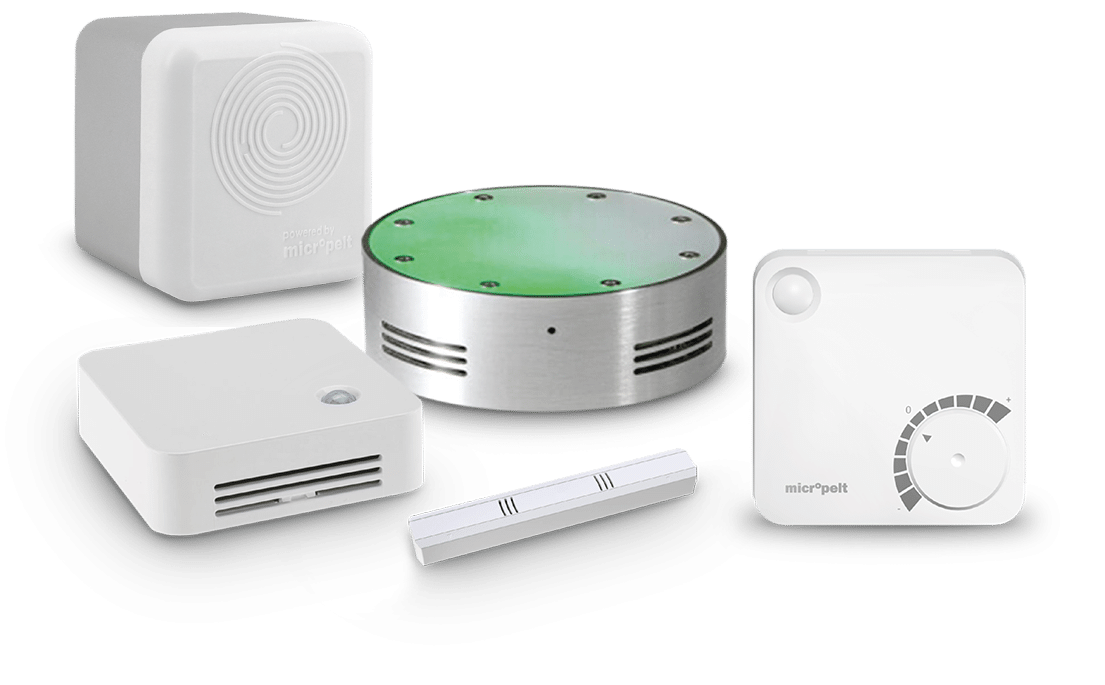
DEOS TEO can be connected to other sensors such as window and door contacts in order to exploit additional savings potential.
Cost-effective infrastructure
The necessary LoRaWAN infrastructure is particularly cost-effective due to its high range and penetration.
Administration in the browser
DEOS TEO can be set up and operated via a web browser. No software installation is necessary.
High security
128-bit AES encryption protects against tampering.
Central control & automation
Temperature control by schedule or usage recording.
Quick and easy configuration
Intuitive configuration software with fast import and export of devices and rooms.
LoRaWAN in building automation
Expand your knowledge of LoRaWAN, wireless sensor technology, and their efficient use in building automation.
Save up to 40 % on heating costs
Saving energy is not only an economic necessity, but also an important contribution to sustainability. According to the BMWi, heating accounts for 70% of building energy costs. This is precisely where the DEOS room solution comes in. Intelligent control of room temperatures and the targeted use of sensor technology make it possible to achieve energy savings of up to 40 %.
The most important measures:
Automatische Absenkung
of the temperature outside the times of use (e.g. at night, at weekends, during vacations).
Individual room control
instead of central overheating or undersupply.
Window contacts
Integration of window contacts for immediate heating switch-off when windows are open.
Optimized heating curves
for energy-efficient operating behavior.
Optimize usage times in buildings
- Central control of room temperatures
- Storage of calendar and time programs
- Expandable through the integration of LoRa sensors:
- Consideration of window opening and presence
- Individual temperature adjustment via setpoint
adjuster
- Air quality control (CO2, humidity)
Wireless installation without interrupting operation
A key advantage of radio-based inventory optimization is the ease of retrofitting. While conventional automation solutions often rely on wired systems that require structural measures, the DEOS TEO room solution is installed completely wirelessly and without interrupting operations.
It’s as simple as that:
- Unscrew the old rotary thermostat
- Attach and fasten the DEOS TEO
- Scan the QR code and integrate it into the control unit
The system is ready for use in just a few minutes per radiator – without any technical expertise. This makes the solution perfect for existing buildings that are to be modernized during operation, for example in schools, office buildings or hospitals.
Maintenance-free & sustainable technology
A particular advantage of DEOS TEO radiator thermostats is their energy self-sufficient operation. While conventional wireless thermostats regularly require new batteries, DEOS TE O generates its own energy – thanks to a patented thermogenerator that converts the heat from the radiator into electrical energy.
- No need to change batteries – reduces maintenance costs and environmental impact
- Durable & sustainable – energy-efficient operation without external power supply
- Robust & tamper-proof – ideal for public buildings
This maintenance-free technology not only lowers operating costs, but also reduces the ecological footprint of building operation.
Intelligent integration into existing systems
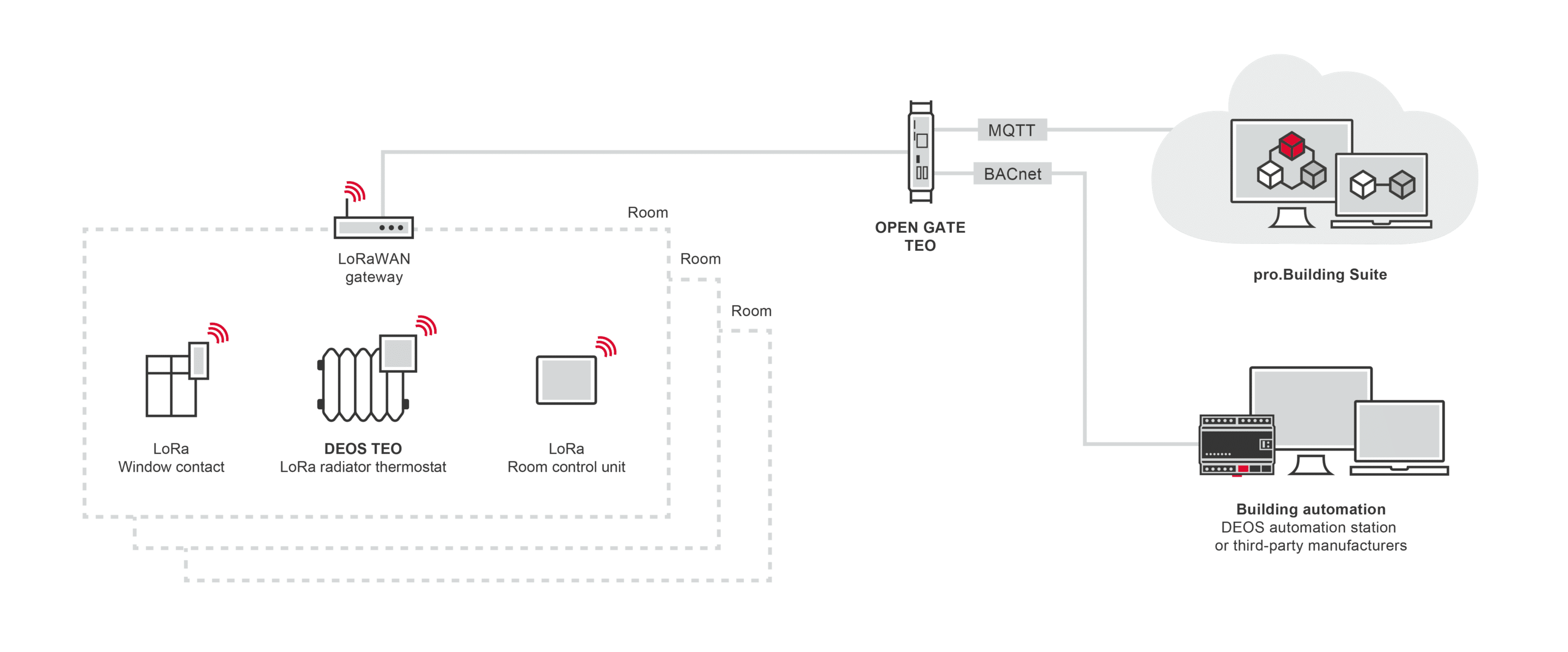
The DEOS room solution can be easily integrated into existing building automation systems – thanks to open BACnet interfaces and the connection to the DEOS OPEN system.
All room parameters can be managed digitally with the central OPEN GATE TEO control system. It is operated via a browser-based interface that enables access and complete control from any location.
OPEN GATE TEO
The OPEN GATE TEO is at the heart of the solution. The central control system, which is based on room logic, is stored here. The OPEN GATE TEO has bidirectional interfaces for connecting the pro.Building Suite and the building automation system. A LoRaWAN gateway is used for communication between the LoRa sensors and the OPEN GATE TEO, which receives/transmits the data via LoRaWAN and is connected to the OPEN GATE TEO via Ethernet.
Radio-based inventory optimization
In this video, Jannik Bals, project manager for radio-based building optimization, presents everything you need to know about LoRaWAN-based room solutions for the efficient refurbishment of existing buildings. Find out, among other things, about a quick and significant reduction in heating costs thanks to DEOS TEO.
From initial concept development to successful implementation – we realize building automation solutions that impress with their quality and reliability . Discover our completed projects in the field of radio-based portfolio optimization and gain an insight into our expertise.
Meinloh Primary School Ulm
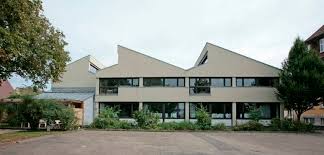
The Meinloh elementary school in Ulm has been able to use the battery-free DEOS TEO wireless radiator thermostats and LoRaWAN technology within heating costs within just two days – with up to 30 % savings potential. The installation was quick and trouble-free during operation, and thanks to an integrated time and calendar system, the heating control is now regulated centrally, automatically and according to demand. Due to the success of the pilot project, the system was also installed in the historic school building, providing the city of Ulm with a future-proof and expandable solution for its building automation.
IKEA Augsburg
To improve the indoor climate and (naturally) also to save energy, IKEA Augsburg was looking for a solution that could be implemented quickly. The heat management was to be more demand-oriented and save costs. In the search for the right solution, all the points listed above spoke in favor of the DEOS TEO wireless radiator thermostat and the LoRaWAN solution from DEOS AG.
IKEA Facility Management easily replaced the first 50 thermostats in this IKEA project section with new ones. They also commissioned the LoRaWAN network with two DEOS gateways themselves. The DEOS LoRaWAN Toolkit is used for operation and central function settings.
St. Franziskus Hospital Münster
In an initial pilot project, 34 DEOS TEO radiator thermostats were installed and put into operation in a ward at St. Franziskus Hospital in Münster. The aim was to achieve a return on investment of less than three years and avoid battery waste from operation.
Even in the first few weeks of operation, energy savings of around 34% were achieved compared to an identical station without DEOS TEO thermostats. If these differences can also be verified in long-term operation, the roll-out to other wards and functional areas will take place quickly. The existing building automation system will be successively adapted.
You might also be interested in: