


Agrippabad Cologne
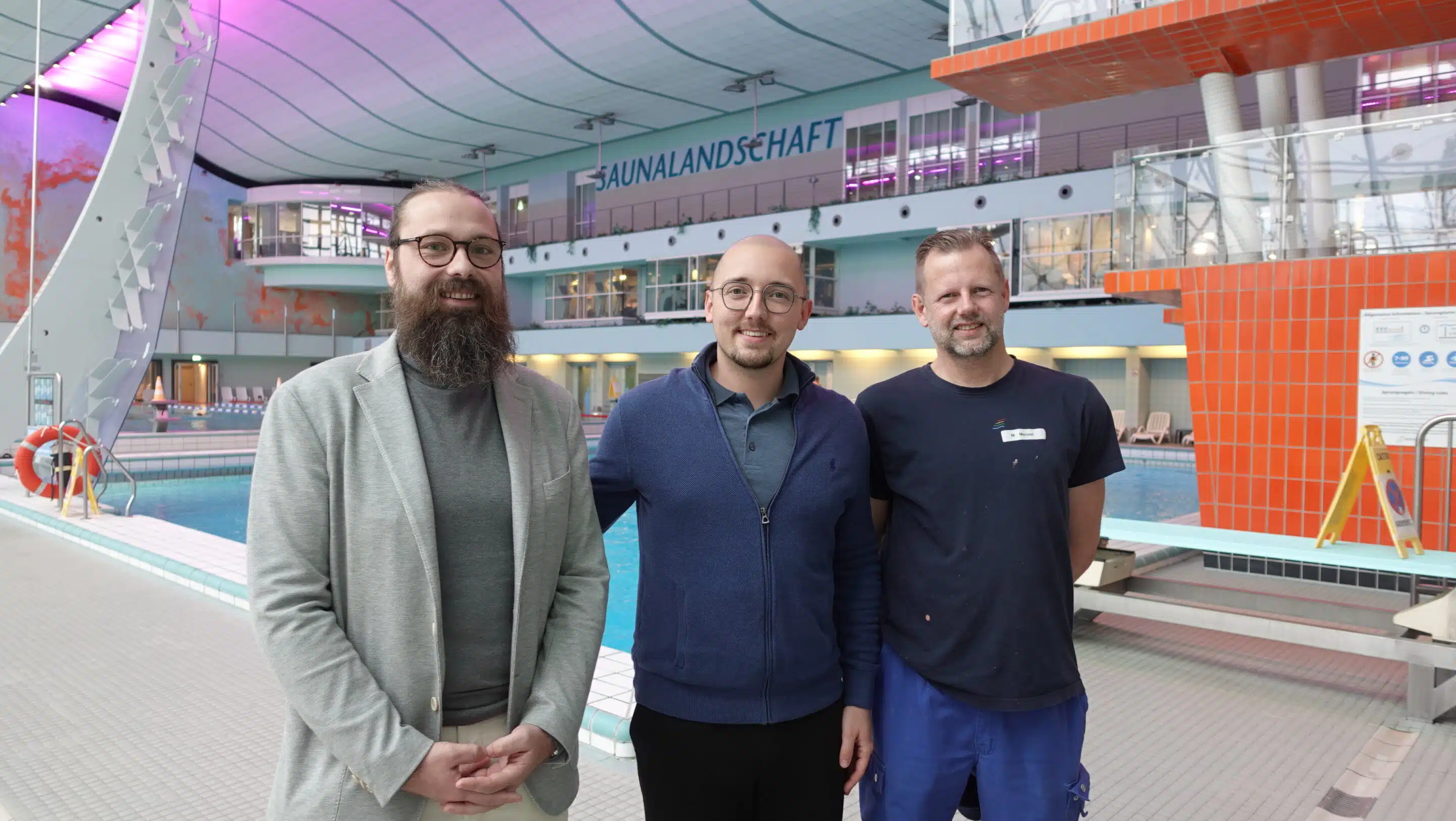

Upgrading the Measurement, Control, and Regulation Systems and Simplifying Operations at Cologne’s Largest Swimming Pool
The main goal of the project was to bring the entire measurement, control, and regulation system up to date—not only to improve operational efficiency and user comfort, but also to significantly reduce ongoing energy costs.
Switching from SE Electronics to DEOS for measurement and control systems: for greater energy savings and optimized operations
Korfmacher GmbH of Cologne, a long-standing certified DEOS system partner, successfully completed the renovation and retrofit of the entire measurement and control system within just six months. Together with DEOS, the manufacturer, both companies contributed their expertise in control and regulation technology, particularly in the field of swimming pool technology.
The technical landscape at Agrippabad, which had evolved over the years and undergone numerous changes, presented a challenging starting point. The standardization of the systems and the centralized visualization of plant processes were therefore the focus of the modernization project.
“Another key aspect of the modernization was improving comfort for our guests and staff,” said Mr. Welter, project manager at KölnBäder. “The indoor areas were often too hot and humid, especially in the summer. We place great importance on ensuring that our guests enjoy an unforgettable experience, but also that our team has a pleasant working environment.”
Implementation of the modernization project
The existing control cabinets for the bathroom systems and the 14 HVAC systems (heating, ventilation, and air conditioning systems), which ensure an impressive air exchange rate of 80,000 to 85,000 cubic meters per hour, were to be retained. Only some of the existing sensor technology was incorporated.
A total of 11 DEOS automation stations (DDC) control the technical systems—in addition to DEOS OPEN EMS 810 units, BACnet/SC-certified DEOS OPEN.WRX automation stations were also installed. These are supplemented by approximately 75 different DEOS IO modules, which serve as interfaces between the individual components.
Thanks to the space-saving design of the DEOS controllers (DDC), the entire retrofit of the building automation system could actually be carried out within the existing control cabinets, which significantly reduced the costs of the modernization project. The DEOS building automation technology and the technical systems now work hand in hand to ensure a harmonious balance between temperature and air quality.Today, the DEOS Touch control units enable graphical control panel operation, allowing for easy monitoring and control of the various technical systems.
In addition, remote access to operational data is enabled via a centrally installed building management system (BMS)—DEOS’s BACnet/SC-certified OPENweb—which significantly simplifies the monitoring and control of all systems at the Agrippabad.
In the field of ventilation technology, humidity control posed a particular challenge, as the building structure could not be compromised. Using the dynamic h-x diagram in the DEOS control system, the various states of the air can be optimally visualized, controlled, and regulated. In conjunction with newly installed sensors from Korfmacher, this ensures that the air conditions in the hall remain continuously within a comfortable range and that humidity is maintained at the desired level.
The new DEOS control system is also being implemented in the area of bathwater technology. Previously, the existing control system attempted to maintain a constant water temperature of 21 degrees—even overnight. The reason for this was that it took up to two days to compensate for a two-degree drop in the pool water temperature. Maintaining a constant pool water temperature was a very energy- and cost-intensive solution.
Conclusion
Life thrives at the heart of the Agrippabad in Cologne—behind the scenes, state-of-the-art DEOS technology ensures fresh air and a pleasant indoor climate that invites visitors to relax and feel at ease. The temperature and humidity in the indoor pool are no longer as high as they used to be, which is also beneficial for the building’s structure.
Since heat meters have not yet been installed, the energy savings cannot yet be quantified. However, it is already possible to observe that the pools heat up more quickly and that pool water temperatures are maintained more consistently.
In terms of time savings for service technicians, a significant reduction in workload is already evident. Centralized trend data now enables better and faster system monitoring, whereas previously readings had to be taken manually on-site in the sprawling basement.
“We’re really impressed with the advice Korfmacher gave us and how much easier everything is now with our new DEOS system,” says Mr. Welter of KölnBäder.
Interest aroused?
Then contact us! We’re glad to help.


